
Real stories · 8 min read

Real love stories from people dating with a disability

What follows are three couples we know. None of them are influencers. None of them have perfect timelines. They each met someone on a disabled dating site and built something good - slowly, with disclosure on their own terms, and with a lot of small, ordinary days. Here is what they wanted us to share.

Why real stories matter more than statistics

Dating with a disability is one of those topics where the numbers tell you something true but never enough. Yes, disabled adults marry at roughly half the rate of non-disabled peers, and 61% report chronic loneliness. But a number can't tell you what it feels like to send a first message at 2 a.m. on a flare day, or to read a profile and think: oh, you actually understand. That's what stories are for.

The three couples below come from different worlds - one interabled, one neurodivergent-on-neurodivergent, one built almost entirely through messages on the spoonie side of the internet. They share one thing in common, which is the thing every disabled-dating-with-a-disability Reddit thread keeps circling back to: they were finally allowed to move at their own pace.

Story one · interabled

An interabled wheelchair couple, five years in

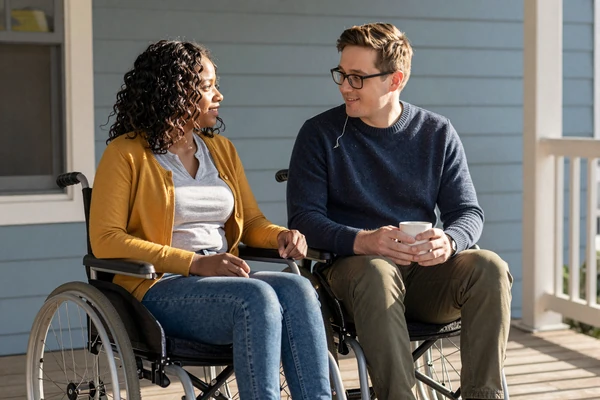
Maya, 34, has cerebral palsy and uses a manual wheelchair. Daniel, 36, is non-disabled. They met on a disabled dating site in early 2021 and have lived together since 2023.

Interabled
Maya, a Black woman in a manual wheelchair, and Daniel sitting together on a sunlit porch with coffee - an interabled couple at home.
I had spent ten years on mainstream apps explaining my chair on the third message. On here, my chair was already in my photos and Daniel just asked what I liked to read. That was the entire opening. Five years later, that is still the energy.
Maya is clear that she did not want a savior. "The first thing I screened for was language," she told us. "Anyone who said 'inspiring' in their first message was out." Daniel had his own filter - he had grown up with a disabled younger brother and knew that interabled relationships work when both people share the planning, not when one person performs gratitude.

What the first six months looked like: long voice notes, no in-person date until month three, and a shared spreadsheet of accessible coffee shops in Portland. Maya picked the venues. Daniel checked the bathroom. Neither of them treated this as romantic - it was just the logistics of two adults who wanted to keep seeing each other. More on the lived experience of dating with CP is on our cerebral palsy dating page.

Story two · autistic-autistic

Two autistic partners who found their pace

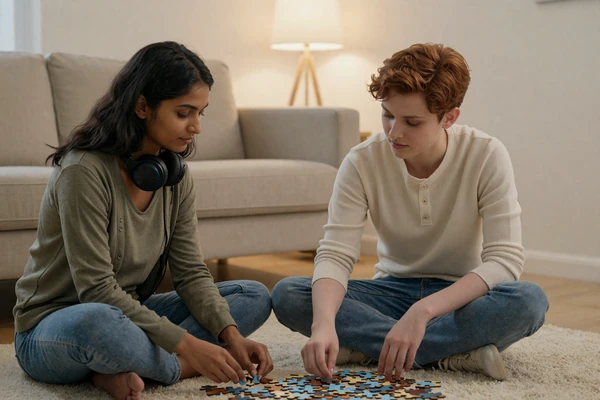
Priya, 29, and Eli, 31, are both autistic. They matched in summer 2024 and got engaged this spring. A 2016 study found autistic-autistic couples often report higher relationship satisfaction than mixed-neurotype pairs - Priya and Eli are a small, specific reason why.

Neurokin
Priya and Eli, an autistic couple, sitting on a rug at home doing a jigsaw puzzle in soft lamp light.
Our second date was a puzzle on the floor. Three hours, almost no words, two cups of tea. Anywhere else I would have failed that test. He sent a text after that said "today was the best date of my life," and I cried, because same.

Priya disclosed her autism in her opening profile line. Eli did the same. "It saved us six dates of guessing," Eli says. They built their relationship on what one autism researcher calls shared communication style - direct, literal, unhurried. They text in long paragraphs. They schedule decompression days after big events. They do not do small talk and do not pretend to.

The harder part was the world around them. Priya's family worried that two autistic people would "struggle together." Eli's last therapist suggested a non-autistic partner would be "easier." They ignored both, found a couples therapist who specializes in neurodivergent relationships, and kept going. Their fuller take on autistic dating is reflected on the autism dating page.

Story three · spoonie pairing

A spoonie pairing built on slow messaging

Jordan, 27, has Ehlers-Danlos syndrome. Sam, 30, has ME/CFS. They messaged for four months before meeting. They have been together two years and have never had a bad first date - because their first date wasn't until they already knew each other.

Spoonie
Other apps wanted me to swipe in 30 seconds. We took 30 minutes a day for four months. By the time we met in person, we knew each other better than people I had dated for a year.

Jordan and Sam's relationship is the one we hear about most often in dating with a disability Reddit threads - the slow-burn message-first pairing. Most days they cannot do a full evening out. So they don't. They do half-dates: two hours on a porch, a video call that ends when one of them needs to lie down, a grocery run together as a real outing. Their lives fit because both of them already lived this way.

What they want others to take from their story isn't a tactic. It's a permission slip. "You are allowed to want a partner who already gets it," Sam says. "That's not a small ask. That's the whole point of a disabled dating site."

Quiet patterns

What their journeys teach about pacing and disclosure

Three couples, three different conditions, three timelines. The patterns underneath them are surprisingly consistent - and they are mostly about giving yourself room.

  • Disclose on your own terms

    Some lead with their disability in line one. Others build rapport first and share later. Both work. The non-deceitful question is when you feel ready, not when a guide tells you to.

  • Slow messaging is a feature, not a bug

    All three couples spent weeks or months in writing before meeting. Long messages let energy-limited and neurodivergent daters show up as their full selves - without performance.

  • Screen for language, not just looks

    Maya filtered out anyone who used the word "inspiring." Priya and Eli wanted "autistic" in the bio, not coded around it. Language is a fast, accurate tell.

  • Half-dates are real dates

    A two-hour porch visit with a heating pad counts. A puzzle on the floor counts. Energy-aware pacing protects the relationship from collapsing under one bad flare.

  • Logistics is intimacy

    Checking the bathroom, sending the parking link, naming a Plan B - these are not chores. Inside an interabled or chronic-illness relationship they read as care.

  • You are allowed to want someone who gets it

    None of these three couples settled for "good enough." They held out for partners who already understood, and they found them on a platform built for exactly that.

Is it okay to date someone with a disability?

Yes - and the question itself is part of why disabled dating spaces exist. Dating a disabled person is the same as dating any other adult: you show up, you listen, you plan together, you share the labor, you let them lead on what their body and life need. The only thing that makes it different is the wider world's assumptions, not the relationship itself.

What is not okay is fetishizing a disability, treating a partner as a project, or wearing the relationship as proof of your goodness. None of the three couples above have time for that, and neither does this platform. If you're approaching dating from a place of genuine curiosity and respect, you are exactly the kind of partner the people in these stories were looking for.

For more on building that confidence on either side, our piece on confidence and self-acceptance in disability dating is a good next stop.

Read more member stories

These three couples are part of a much wider community. Browse real profiles and stories first, or join free when you are ready.

Free messaging on the core tier. No devotees. Privacy first, always.