
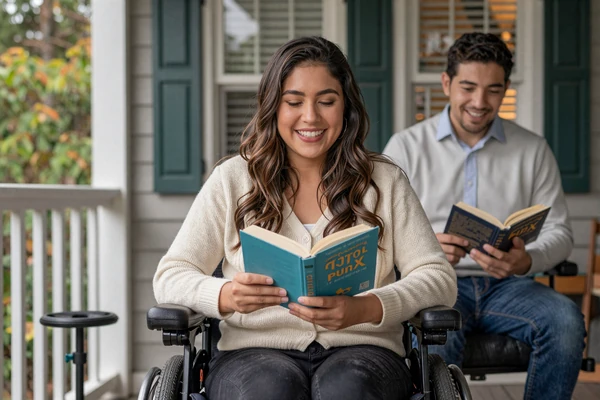
Maya & Theo
I matched with Theo on a Tuesday. By Friday he had texted me three accessible bookstore options for our first date and asked which sounded best. Reader, I picked the one with the cat.
A space for wheelchair users - power chair, manual, full-time, part-time - and partners who treat accessibility as a shared pleasure, not a chore. Lead with personality, not paperwork. Free messaging, no devotees, real conversations.
Free to join. Free to message. No card required. Strict no-devotee policy, always.
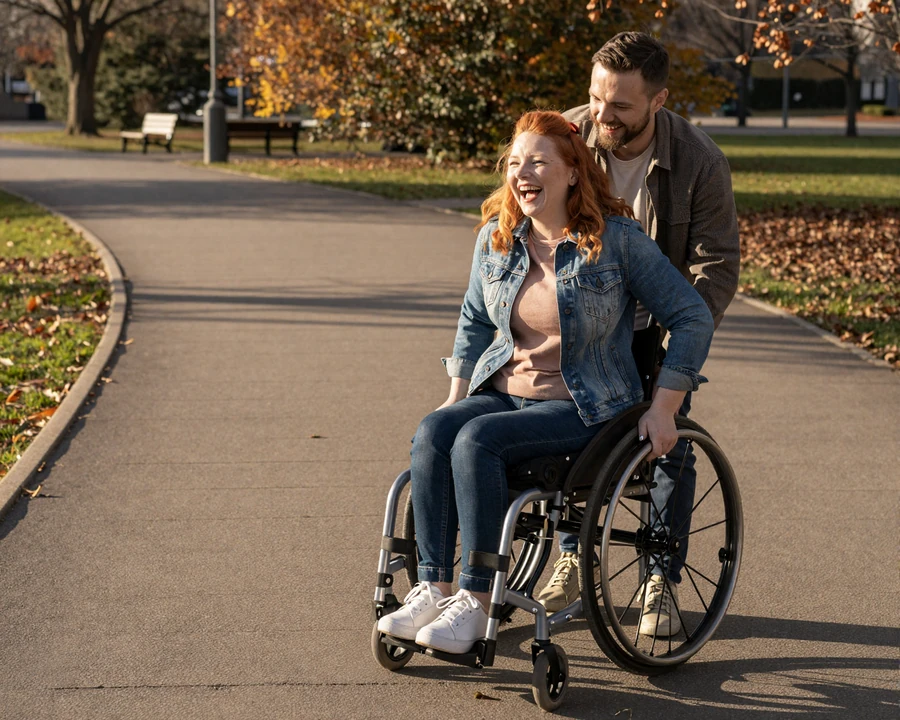
If you've spent a few years on Tinder or Hinge as a wheelchair user, you already know the routine. The match goes well. You disclose. You wait. The conversation cools, or - somehow worse - it gets warmer in a way that feels off. The person starts asking about your chair the way people ask about a sports car. That's not chemistry. That's a fetish, and you deserve to skip it entirely.
This category exists for a few overlapping groups. Wheelchair users looking for a partner who plans accessible dates as a shared act, not a sigh. Ambulatory partners who already know that "accessible" should mean step-free and step-up - and that calling ahead to a restaurant is a normal part of date prep. People in interabled relationships wanting community with others who get it. Manual, power, part-time, full-time, lifelong, post-injury - all welcome. There is no single way to be a wheelchair user, and there's no single way to date as one.
Wheelchair dating itself is a defined niche - the search term sees roughly 110 monthly U.S. searches, and platforms like SingleDisabled.com and Whispers4u have served wheelchair users for over two decades. What still feels missing on most apps: a place that doesn't treat the chair as the headline. Here, your profile leads with what you read, where you walk (or roll), and what you laugh about. The chair is a fact, not a tagline.
We say "wheelchair user," not "wheelchair-bound" or "confined to a wheelchair." A chair is freedom, not confinement. If you prefer different wording on your own profile, you write it - we don't autofill identity for anyone.
A short rule from longtime wheelchair daters: investigate access before you arrive, not after. "Accessible" means different things to different venues - a quick phone call beats a curb at the door.
Most U.S. museums are ADA-compliant - wide aisles, elevators, accessible bathrooms. Quiet, talkative, perfect for a first or second date.
Small general-admission venues often give wheelchair users stage-side platforms - better sightlines than most paying fans get.
Most lanes have accessible ramps. Quadriplegic players can use a mouth stick. Low-pressure, playful, and almost always step-free.
ADA seating is excellent at most modern venues - companion spots beside wheelchair spaces, no pillars in the way.
Skip the sand - wheels and beach do not mix. A boardwalk at golden hour is an underrated romantic setting.
Free, accessible year-round, and quietly romantic. Bring a flask of cocoa, share a playlist, look up.
For more on planning, read accessibility in dating: a practical guide.
The honest answer: dating a person in a wheelchair is dating a person. The chair is a mobility tool - like glasses, like a cane, like a car. It's not a personality. The shared humor, the inside jokes, the disagreements about pizza toppings - that's the relationship. The chair is a fact along the way.
That said, a few specific habits matter, especially early on. They're small. They make a big difference.
Most wheelchair users see the chair as their legs. Pushing it without consent is, as one member put it, "like picking someone up and carrying them without permission." Ask first. Always.
Eye level matters. If you can sit beside them at a cafe table, do. If you are standing, step back a foot so they are not craning up. Tiny adjustment, huge signal.
Doing the homework on venue access is generous. Steamrolling the choice is not. Bring two or three accessible options and let your date pick.
Sliding into "caretaker" mode too fast kills the romantic charge. Hold a hand. Refill a drink. Wait to be asked for the rest.
How they transfer, what they want help with, what they prefer to do solo. The answer is theirs to give. Direct questions, kindly asked, beat polite guessing every time.
Romantic beach walks sound great until the front casters hit dry sand. Save the beach for an accessible boardwalk. Save cobblestones for a different date entirely.
"You're so brave for being out here" lands like an insult. They're out here because they wanted dinner. So did you.
On their disability, on their chair, on their needs. They've lived in this body longer than you've known them.
"The biggest green flag a date ever showed me was knowing the secret accessible entrance to the theater. They\'d already looked it up. I knew right then we\'d get a second date."
- Member, Chicago, ILAn interabled relationship is one where one partner is disabled and the other isn't. They are common, normal, and - when built well - deeply ordinary. They also require some honesty about labor and assumptions.
Disability advocate and Disability After Dark host Andrew Gurza describes the structural inequity bluntly: "I am the one who has to figure out accessible transit, I have to call ahead and know what restaurants or bars will accommodate me and my chair." If you are the non-disabled partner, this is the work that quietly piles on your wheelchair-using partner unless you actively share it. Researching access. Vetting venues. Confirming a curb cut. Calling ahead. It's not "just planning" - it's a tax that doesn't fall on most couples, and it adds up.
The fix isn't to take over decision-making. It's to do the homework and bring it back. Two or three checked-out options. Final call goes to your partner. That's accessibility advocacy without erasing autonomy.
Disability educator Vix Jensen-Collins describes what an effective non-disabled partner looks like: someone who "never questions how I'm feeling on a certain day, whether my pain or exhaustion can be ignored." If your partner says they are tired, they are tired. If they say they want to go home, you go home. The body doesn't owe you a debate.
The myth that a disabled partner is a burden runs deep. Family members may say it out loud. Friends may hint at it. Strangers will sometimes praise the non-disabled partner for "putting up with so much." All of it is ableism, and unlearning it is ongoing work - not a one-time decision.
Writer Lizz Schumer, who has fibromyalgia, described her approach: "I told him during our first date that I was dealing with some health issues and he could either come along for the ride, or not." That's not a warning. It's a doorway. The right person walks through it.
Couples like Niamh and Karl - both wheelchair users, documented by the UK charity Whizz Kidz - describe needing "enough space for our wheelchairs, step-free access and a changing places toilet" as essentials for a good date. Two wheelchair users dating each other have their own dynamic; Sophie Dearman, a Whizz Kidz volunteer, met her non-wheelchair-using partner Charlie as a child in hospital and married him as an adult. Different stories, same throughline: shared humanity first, logistics handled together.
Read more on this in our guide to partner expectations in interabled relationships.
Edited for length, shared with permission. Names and a few details are changed for privacy.
I matched with Theo on a Tuesday. By Friday he had texted me three accessible bookstore options for our first date and asked which sounded best. Reader, I picked the one with the cat.
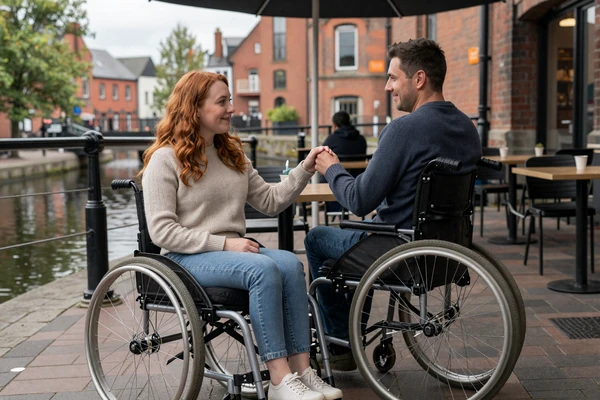
Two wheelchairs at one table is a logistics puzzle most cafes don't expect. We pick spots with space, step-free access, and a changing places toilet. Karl makes me laugh harder than anyone. That part is easy.
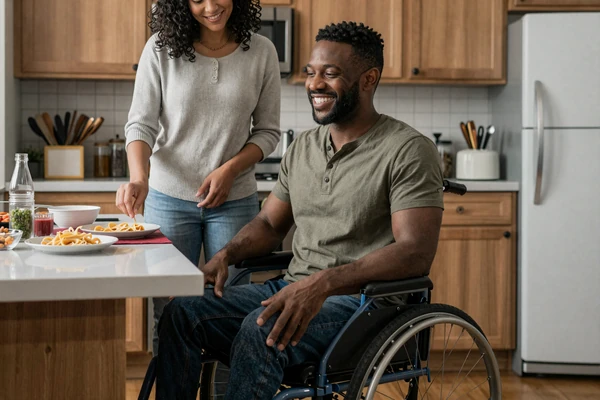
I prefer home dates first. My kitchen is set up the way I move. We cook, we talk, no parking puzzle. If someone says no to that, they were never the right match anyway.
Mood tags help conversations start on the right note. Pick a few that feel like you. Skip the ones that don't.
Wheelchair dating sits alongside a handful of overlapping spaces. Members often join more than one.
Confidence after limb loss, prosthetic disclosure, and the same anti-devotee protections.
CP is a spectrum - many members use chairs, many don't. Own your story, find someone who learns with you.
Pre-date venue research, accessible date ideas, and how to share planning labor.
For interabled couples - sharing labor, avoiding savior framing, healthy expectation-setting.
The questions we hear most from wheelchair users and their partners. For more, see our full FAQ page.
Yes - several. Personal Singles Dating offers a wheelchair-focused community within a wider disabled dating site, with free messaging and accessible profile flows. Other platforms include Dateability (founded 2022), Whispers4u (running since 2002), SingleDisabled.com, and Special Bridge. There is no single dominant "Tinder for wheelchair users," but disability-focused apps consistently report higher satisfaction than mainstream apps, especially for screen-reader and dexterity accessibility.
Date them like you'd date anyone - with one extra habit. Plan for access. Confirm step-free entry, accessible restrooms, and table height before the date. Never push the chair without asking. Talk to your date, not the chair. Treat them as the expert on their own body. The chair is a mobility tool, not the relationship. The relationship is the same shared humor, disagreements, and connection any couple builds.
Yes, with care. Ask the way you'd ask about any part of someone's life - out of curiosity, not interrogation, and only after the conversation has earned it. Let them lead on what they share. Avoid medical questions early on ("what happened to you?" is the classic misstep). "How can I help plan a great date for you?" almost always lands well.
Of course. Interabled relationships are common and can be deeply healthy. The work for the non-disabled partner is unlearning ableist assumptions actively, sharing accessibility planning labor, and trusting your partner when they describe their own body. If you can do those three things - and not slip into a savior or caretaker frame - you are in a strong position to build something real.
You decide. Many wheelchair users lead with it because they want to filter for partners who already get it - saving the disclosure tax of mainstream apps. Others share more privately as conversation deepens. Both are valid. Our profile builder offers structured fields and free-text "about me" blocks so you can disclose at your pace.
Personal Singles Dating has an explicit no-devotee policy in its terms. Profiles signaling fetishization - through language, photo choices, or message patterns - are removed. If a match feels off (excessive focus on the chair, requests for specific photos of you in it, language that treats disability as a kink), block and report in one tap. Our moderation team follows up. You can read our full safety and privacy approach.
Not at all - they are everywhere once you know where to look. Museums, art galleries, movie theaters, live music venues, bowling alleys, zoos, aquariums, accessible parks, sports stadiums, and home dates are all wheelchair-friendly. The 2024 Amputee Coalition data is a useful reminder that 62% of disabled people delay dating for over a year post-diagnosis, often because of family stigma. Lack of accessible options is a smaller barrier than it feels - confidence and access information do most of the work.
You're welcome here. Many members are part-time wheelchair users - for fatigue, pain, or fluctuating conditions. You can describe your disability however feels accurate ("ambulatory wheelchair user," "uses a chair on flare days," "spoonie"). The point of structured profile fields is precision, not labels.