Dating with cerebral palsy • Free messaging

Finding love with a disability - with cerebral palsy at any independence level

Cerebral palsy is a spectrum, and so is the love that finds you. Whether you walk independently, use a power chair, type with a head pointer, or speak through an AAC device, you are dateable, partnerable, and worth the long story. This is interabled dating without the savior framing - and same-disability dating without anyone having to explain spasticity twice. Story-led profiles, mood tags, free messaging, and a community that already gets it.

Free to join, free to message. Photo verification on every profile. No devotees, ever.

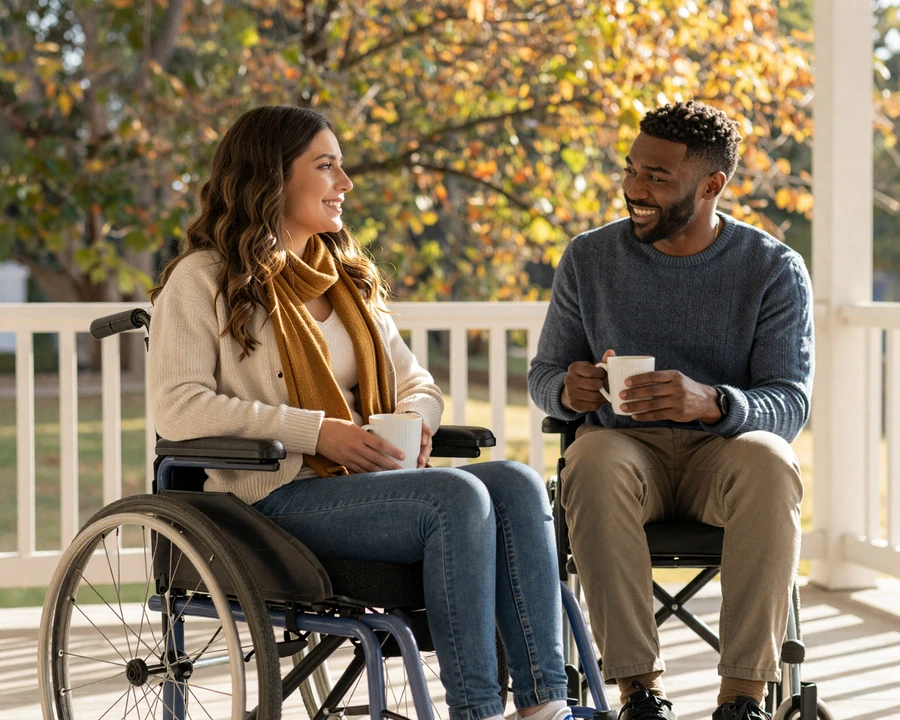
Marisol, a Latina woman with cerebral palsy, laughing on a sunlit porch with her partner Devon - interabled dating with cerebral palsy
The starting point

CP is a spectrum - and so is dating

Cerebral palsy affects roughly 1 in 345 children in the United States (CDC, 2023), and almost all of them grow into adults who want what every adult wants - friendship, intimacy, romance, the small daily kindnesses of a shared life. The trouble is that "cerebral palsy" gets used as if it were one thing. It is not. It is a category, and the people inside it look very different from each other.

Some of us walk without aids and live a fully independent life - driving, working full-time, parenting toddlers, training for accessible cycling. Some of us use a manual or power wheelchair and need help with transfers but otherwise run our own days. Some of us use AAC devices to speak, hire personal care assistants, and live with significant support - and still have very full, very real love lives. None of these versions is more or less ready for love than another.

The dating part of the spectrum is just as wide. CP daters here include:

  • Independently mobile CP singles who often look "able-bodied" until subtle balance or coordination differences come up. Disclosure timing is the recurring question.
  • Wheelchair users with CP who want partners - disabled or non-disabled - comfortable with a chair as part of daily life, not a tragedy to overcome. See our wheelchair dating community for more.
  • CP singles with speech differences or AAC users who deserve patient partners who listen at the pace the device runs, not the pace the partner expects.
  • CP singles seeking other CP partners for the shared-experience comfort, and CP singles seeking interabled relationships for the contrast and complement. Both are great. Neither is better.

The unique angle here is one we keep coming back to: a CP love story is not a miracle. It is a relationship. Dan Keplinger, the subject of the Academy Award-winning documentary King Gimp, lives with severe cerebral palsy and once thought he would grow old alone. Then a viewer named Dena saw the film, became a fan, then a friend, then his wife. They are not a fairy tale. They are an introvert and an extrovert who built a marriage on letters, time, and stubborn affection. That is the rule of CP dating, not the exception.

Disclosure on your terms

Owning your narrative, not apologizing for it

Disclosure is your decision, every time. The research and our members both confirm: there is no single right moment, only the moment that feels right to you.

A 2025 study by Mimoun et al. in Stigma and Health found that earlier disability disclosure in dating produced less negative emotional residue and led to more open, authentic connections than late disclosure. That data point matters - but it is not a rule. It is a permission slip. If you have wanted to lead with your CP and felt selfish for it, you do not have to feel selfish anymore. Leading is a valid strategy, and it filters fast.

The flip side is also true. Some CP daters share gradually - a mention of physical therapy in week two, a chair photo on the profile only after a few good messages, the whole story over coffee in person. Rooted in Rights writer Amy Gaeta described this as opportunistic disclosure: a relevant topic comes up, you let your CP enter the conversation naturally, and trust grows on both sides. No interrogation. No grand reveal.

What is non-negotiable is that the disabled person decides. Not the partner, not the partner's family, not the dating app's drop-down menu. You.

"Disclosure is a vital act of agency and maintaining control over our rights, while still leaving ourselves open enough to love and be loved."

- Disability disclosure researcher, 2024

Three approaches that work

Profile-first. CP and a chair photo on your profile. Filters out the un-curious before message one.

Conversation-natural. Mention it when something relevant comes up - a venue, a hobby, a question about your week.

Pre-meet phone or video. Speech, movement, and chair are visible before the first in-person date, removing the surprise.

For deeper guidance, see our inclusive dating advice and the confidence and self-acceptance guide - both written with disability disclosure as a recurring theme.

Sustainable openness

Educating partners without burning out

Disabled people are often expected to be free educators on demand. You are allowed to set the pace, the depth, and the off-switch. Here is how to share enough without giving the lecture every Tuesday.

  • Lead with the lived part, not the medical part

    Your partner needs to know how CP shows up in your life - energy, transfers, speech pace - long before they need the textbook etiology. Save the diagnosis paragraph for if they ask.

  • Curate a few trusted resources

    Send a Cerebral Palsy Foundation explainer, a podcast episode, an article a CP friend wrote. You did the curation once. They can do the reading on their own time.

  • Name what you do not want to be asked

    "I am happy to talk about how I move. I am not interested in talking about whether I can have kids on the third date." Boundaries said early protect both of you.

  • Use the off-switch without guilt

    "I am tired of explaining today. Can we just watch the movie?" is a complete and loving sentence. Education fatigue is real, and a partner worth keeping respects it.

  • Welcome curiosity, not interrogation

    There is a difference between "what is your speech device called?" (curiosity) and "but how do you, you know…?" (interrogation). The first is welcome. The second is yours to redirect.

  • Let your community do some of the work

    Friends with CP, online groups, this community - when a partner can hear the experience from more than one disabled person, you stop being the entire curriculum.

Our partner expectations in interabled relationships guide goes deeper on the caregiving-vs-partnership boundary - essential reading if your CP needs ongoing physical support from a partner.

Shared logistics

Accessible date planning, shared between you

A core CP dating tip: investigate venue access before arriving, not after. The bigger principle is that planning is a shared act of love - not the disabled partner's tax for being included.

  • Call the venue, not the website

    Websites lie about access in cheerful pastel boxes. A two-minute phone call asks the real questions: doorway width, accessible bathroom, ramp grade, table heights, lighting for lip-reading if relevant. Either of you can make the call.

  • Decide together who handles what

    Maybe you research the cuisine and they call the restaurant. Maybe they drive and you book the tickets in your accessible-seating account. Default to "we plan" rather than "they plan around me."

  • Build energy into the date, not just the route

    CP fatigue is real. A two-hour outing with a sit-down middle beats a four-hour walking tour, even if the four-hour version sounds romantic on paper. Plan to your actual battery, not your ego.

  • Have a graceful Plan B ready

    Spasticity flares. Weather changes. Transport falls through. A backup home date - soup, a film with captions, candles - is not a downgrade. It is a sign of a couple that knows itself.

  • Check transitions, not just destinations

    The bar is accessible, but is the sidewalk between the parking and the bar? The museum has an elevator, but does the cafe inside? Door-to-door thinking saves the evening.

  • Keep at-home dates in regular rotation

    Cooking together, board games, a music night, a slow morning with the same pot of coffee. Home dates remove access friction entirely and often produce the best conversations of the relationship.

For more, our accessibility in dating guide covers pre-date venue research, accessible date ideas, and what shared planning labor really looks like across different disabilities.

Browse the community first

See real CP profiles, story-led prompts, and mood tags. No card required to look around.

Photo verification on every profile. No devotees. Free messaging on the core tier.

Real couples

Real CP couples on finding each other

In the spirit of Dan and Dena. Edited for length, shared with permission. Names and identifying details changed for privacy.

Warm · Direct
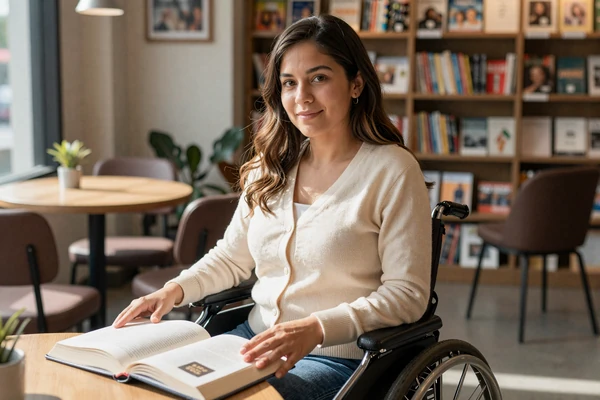
Marisol, a Latina woman with spastic cerebral palsy, smiling in her power chair at a bookstore cafe - dating with cerebral palsy story

Marisol, 32

I led with my chair on my profile. First photo, no apology. The men who could not handle that filtered themselves out, which saved me three years of bad coffee dates. Devon read every prompt and asked about the book on my lap before he asked about my CP. That was the tell.

Patient · Curious
Henry, a man with mild cerebral palsy, holding his cane on a Boston brownstone stoop in autumn - finding love with a disability

Henry, 38

Mine is mild enough that nobody notices until we walk for ten minutes. I used to wait until date three to mention it. After a couple of cold reactions I switched to a small line on my profile. The matches dropped. The good ones stayed. Met Annika that way.

A note on the Dan Keplinger story

Dan Keplinger, the artist at the center of the 2000 Academy Award-winning documentary King Gimp, has severe cerebral palsy. In the film he imagines growing old alone. By 2009 he was a working artist married to Dena, who had first contacted him as a fan after watching the documentary on HBO. They wrote letters. They reconnected over years. They fell in love after a speaking engagement trip and married. He is an extrovert; she is an introvert. The lesson is not that miracles happen. The lesson is that love, when it lands, is uninterested in the prognosis section of anyone's chart.

Read more interabled and CP couple success stories →

Common questions

Cerebral palsy dating questions

The questions we hear most from CP members and their partners. For more, see our full FAQ page.

Can people with cerebral palsy date and have relationships?

Yes. Adults with cerebral palsy date, fall in love, marry, and start families across every level of the CP spectrum. Common obstacles are external - physical accessibility of venues, media underrepresentation of disabled people in full lives, and self-doubt absorbed from a culture that rarely shows CP as romantic. None of these are limits on the relationship itself. CP couples include same-disability pairs, interabled pairs, and long marriages of every shape.

When should I tell a date that I have cerebral palsy?

Whenever you decide. A 2025 study in Stigma and Health found that earlier disclosure tended to produce more open and authentic connections with less negative emotional residue, but that is research, not a rule. Many CP daters lead with their disability on their profile to filter for understanding partners. Others share gradually - a relevant mention here, a chair photo there, a fuller conversation in person. The decision is always yours.

How do I find partners who actually understand CP?

Disability-aware platforms like ours filter the dating pool from the start - every member is here because they want a community where disability is not a deal-breaker. Beyond the platform, CP-specific online groups, adaptive sports communities, and disability advocacy spaces are where many couples meet. Look for partners who ask questions out of curiosity rather than pity, and who follow your lead on what to discuss and when.

Is interabled dating with CP harder than same-disability dating?

Different, not harder. Same-disability CP couples often skip the translation work - they already know what a spasticity day feels like or what an AAC pause means. Interabled CP couples gain contrast, complementary energy, and a partner who experiences the world from a different angle. Both have their own conversations to have. Neither is a downgrade. Many of the strongest relationships in our community are interabled.

What if my partner cannot communicate verbally because of CP?

Then communication happens through whatever tools work - AAC devices, typing, gestures, picture boards, eye-gaze technology, written notes. The partner's job is to slow down and listen at the pace the system runs, which is a different pace than spoken conversation. Plenty of love letters in human history were written, not spoken. The relationship does not need verbal speech to be real.

How do we plan dates when one of us has CP?

Together. Default to shared planning rather than the disabled partner doing all the access research alone. Call venues directly to confirm accessibility - websites are often wrong. Build energy reserves into the date itself, with a sit-down middle and a graceful Plan B if a flare happens. Keep at-home dates in regular rotation; they remove access friction entirely and often produce the warmest conversations of the relationship.

How do I educate a partner about CP without burning out?

Lead with the lived experience, not the medical etiology. Curate two or three trusted resources - an article, a podcast, a CP friend's blog - and let your partner do their own reading on their own time. Name what you are not interested in being asked. Use the off-switch ("I am tired of explaining today, can we watch the movie?") without guilt. Let community do some of the educating so you are not the entire curriculum.

What about devotees and fetishization?

No, never welcome. Our platform has an explicit no-devotee policy. People who fetishize CP, wheelchairs, AAC devices, or any disability are removed when reported. CP daters describe devotees as exhausting and dehumanizing - the opposite of being seen as a whole person. If anything feels off in a conversation, our reporting tool is one tap away and reviewed by a human within 24 hours.

Is the cerebral palsy dating site free?

Yes. Free signup, free messaging, free profile, free browsing on the core tier. We added an optional premium layer for advanced filters and verification, but the messaging that builds real relationships is free for everyone. We know affordability matters, especially for CP singles on fixed disability income - pricing should not be the gate.

Join free today

Bring your full story - speech, chair, cane, AAC, all of it. We built this so you do not have to apologize for any of it.

Free on the core tier. No card required. No devotees. Photo verification on every profile.