
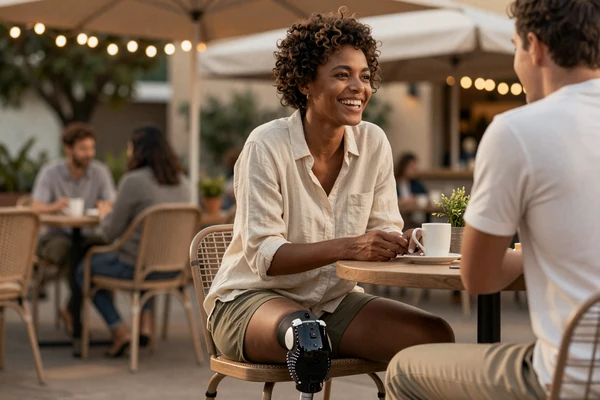
Renee, 34
I put the prosthetic in two of my five photos. Three days in, Marcus asked if I had a favorite seated restaurant - he'd already looked some up. We are eight months in. He still asks before he plans things. I still appreciate it.
An amputee dating site for people rebuilding confidence after limb loss - and partners who see a whole person, not a prosthetic. Above-knee, below-knee, upper-limb, congenital limb difference, all welcome. Free messaging, story-led profiles, and a strict no-devotee policy that we actually enforce.
Free to join. Free to message. No card required. Devotees and fetishizers removed on sight.
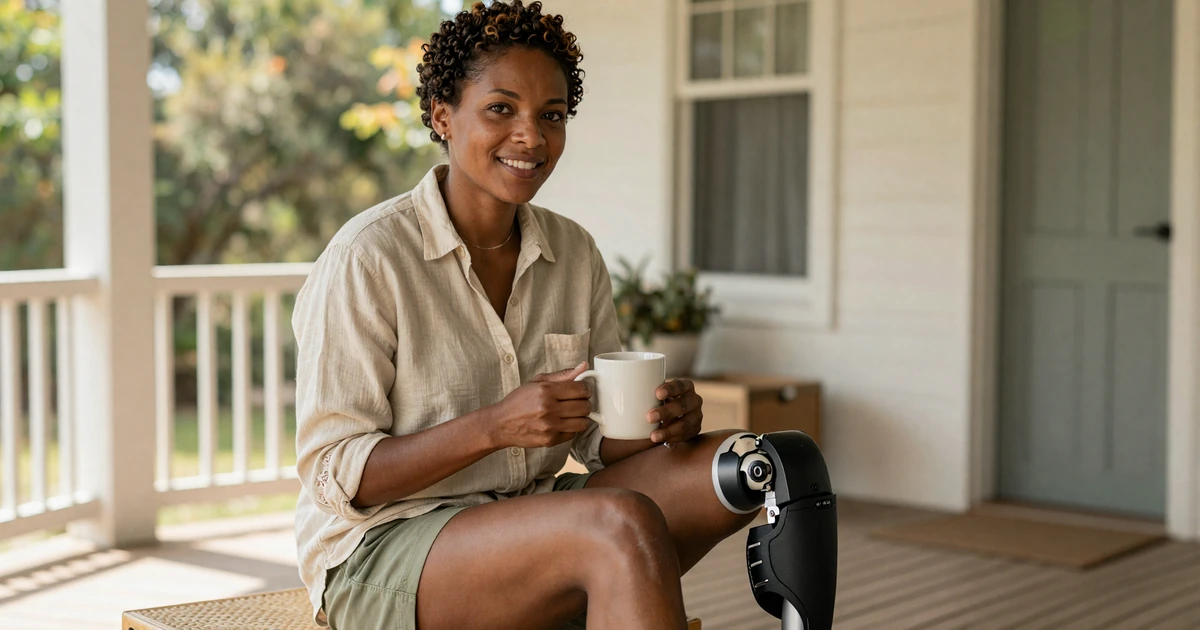
Limb loss changes the body. It does not change the person. That sentence is easy to type and hard to live, and most amputees know it can take years before the second half lands fully. According to the Amputee Coalition's 2024 prevalence study, more than 5.6 million Americans - roughly 1 in 62 people - live with limb loss or limb difference. You are in very large company. The dating part still feels lonely sometimes, and that is a real feeling worth naming, not arguing with.
The data on body image and amputation is more nuanced than the stereotype. A study published in PLOS ONE of 149 lower-limb amputees found significantly lower body image scores compared to controls (p<0.001) - but the same research found self-esteem, the core sense of worth, was not significantly diminished by lower-limb amputation itself. Body image is how you feel about your body. Self-esteem is how you feel about yourself. Those are different things, and the second is the foundation that dating actually rests on.
"The people worth being with respond to the person - how I carry myself, whether I create warmth, whether our values line up. Not a comparison to some whole-limbed version of me that does not exist."
- Member reflection, 18 months post-amputationThe honest timeline: a 2024 Amputee Coalition survey found 62% of amputees delayed dating for over a year post-loss, often because of family stigma rather than personal readiness. Adjustment is also not linear - research found amputees were more dissatisfied with body image 6-10 years post-amputation than at other windows. If your confidence dips four years in, that is not failure. It is the curve catching up with you. Be patient with the rebuild.
One practical, evidence-backed lever: a study in Scientific Reports found a positive correlation between body image and physical activity in lower-limb amputees. Movement - adaptive sports, walking with a stable prosthetic, swimming, cycling, even gardening - feeds the body image piece in a way no affirmation alone can match. So does community. So does the slow, ordinary work of treating yourself like someone you would like to date. We have a longer guide on this in confidence and self-acceptance.
Ablesingles' 2026 Confidence Blueprint warns against "doing someone else's thinking for them" - assuming a match would not want to date an amputee, then quietly ghosting before they get the chance to decide. Studies consistently show that partners are often more accepting and adaptable than amputees anticipate. Let people make their own call.
There is no single right answer to when you mention your amputation. There are two well-tested approaches, and both work - pick the one that matches your energy, not someone else's rule.
Mention the amputation in your bio, include a photo where the prosthetic, residual limb, or empty sleeve is visible. This filters for open-minded partners from the start and removes the mid-conversation surprise. It also takes the disclosure tax off your shoulders entirely - the right people self-select in.
Best for: visible amputations, members tired of mainstream-app disclosure cycles, anyone who wants the chair, the prosthetic, and the personality on equal footing from message one.
Build a few real conversations, then bring it up once there is something genuine to build on. This is especially common for below-knee amputees whose prosthetic is less visible day-to-day. The disclosure becomes part of the relationship, not the headline.
Best for: members who want chemistry to lead, anyone whose amputation isn't centrally part of how they describe themselves, and those who prefer voice or video to texted disclosure.
"Hey - wanted to mention before we meet that I lost my leg a few years ago and use a prosthesis. It doesn't change my daily life much, but I like to be transparent early on. If you have any questions, feel free to ask."
That tone - calm, factual, an open door rather than a confession - does most of the work. It signals that the topic is not loaded for you, which gives the other person permission to treat it the same way. If they respond with curiosity, good sign. If they respond with a pity face, an over-correction, or a sudden interest in the prosthetic itself, that is information too.
For first dates, practical tips: choose accessible venues like coffee shops, seated meals, or movies; plan shorter dates so prosthetic comfort stays manageable; bring backup supplies on overnights. None of that is unromantic. It is grown-up planning, the same kind any thoughtful date does.
"Devotee" is the polite word for someone who fetishizes amputation. The visible amputee population is small enough that most of us have run into it - a match whose questions tilt fast toward the residual limb, or who asks for specific photos that have nothing to do with knowing us as a person. It is exhausting, it can feel violating, and on a regular dating app it is rarely policed.
Devotees are not welcome here. Profiles that fetishize amputation, limb loss, prosthetics, or any disability - through bio language, photo requests, message patterns, or coded community references - are removed. Members can block and report in one tap. We action reports within 24 hours, and we do not give offenders a "second chance" with the same victim pool.
What that looks like in practice. We screen at signup for known devotee community keywords. We auto-flag message patterns that index heavily on limb-related questions in the first ten exchanges. We weight member reports - three independent reports for fetish behavior trigger an immediate review. And critically, we do not use a generic "Tinder for disabled people" search-and-discover model where the platform passively serves up amputees to anyone curious. Members opt into being seen, with control over who can message and view.
The wider context matters here. Research on disability stigma (Deal, 2003) shows that stigma is not evenly distributed - some disabilities carry more societal bias than others, and visible physical differences sit in a difficult spot: more accepted than some conditions, but also more fetishized. Building a platform that protects against that fetishization is not optional. It is the whole job. Read more on our broader approach in safety and privacy.
If you ever feel a match has crossed the line - even if you cannot quite articulate why - trust that instinct. Block, report, move on. We will follow up. You do not owe an explanation to anyone who treats your body as a kink.
Your photos do more than show what you look like. They communicate accessibility context, signal personality, and either filter for compatible partners or invite assumptions you'd rather skip. A short, practical guide for amputee members.
If you use a prosthetic daily, include it in at least one photo. If you sit more than you stand, show yourself seated. Authentic beats aspirational every single time.
Wheelchair basketball practice, gardening, the gaming station, a bookshelf, the kitchen mid-cook. Activity photos generate more genuine matches than studio-style shots.
Helps potential matches feel at ease reaching out instead of wondering. You don't need to perform - a hallway mirror, a friend's phone, natural light.
Looking at the camera, soft posture, a real smile or a real neutral face. Forced smiles register as forced. So does forced confidence - be the comfortable version of yourself.
No street signs, mail with addresses, workplace lanyards, or shots that show your apartment number. Same photos as your other social profiles can be reverse-image-tracked too.
If standing for photos hurts or fatigues you, sit. If wearing the prosthetic that day is a no, leave it off. Authentic photos taken on a comfortable day always outperform performative ones.
More on profile writing in our inclusive dating advice guide.
Edited for length, shared with permission. Names and details are changed for privacy.
I put the prosthetic in two of my five photos. Three days in, Marcus asked if I had a favorite seated restaurant - he'd already looked some up. We are eight months in. He still asks before he plans things. I still appreciate it.
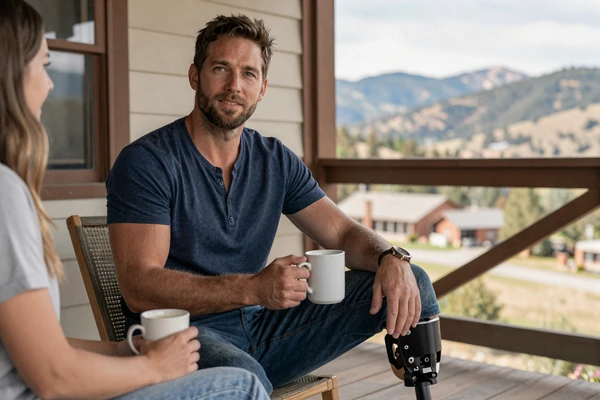
Mainstream apps wore me out. The disclosure conversation, every time, in writing. Here I led with it. The first message I got was about adaptive cycling, not my leg. That was the difference.
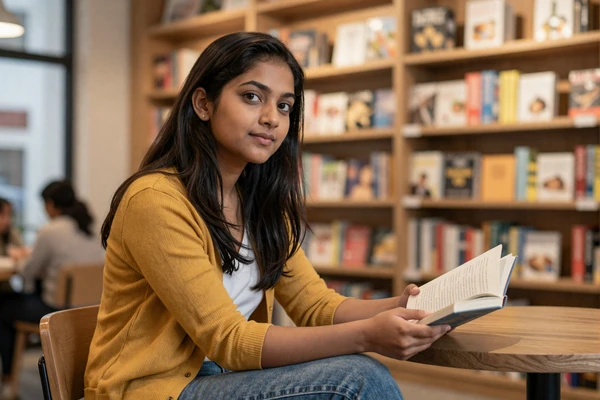
I grew up with my limb difference, so it has never felt like a story. The matches I keep are the ones who get that. They ask about the book in my photo, not the arm holding it.
Amputee dating sits alongside several overlapping communities. Members often join more than one.
For wheelchair users - manual, power, part-time, full-time - and partners who plan accessibility together.
Real couples across disabilities - wheelchair, autism, deaf, chronic illness, little person, PTSD recovery.
Owning your story, the dateable self-esteem concept, and confidence-building activities that actually move the needle.
Eight characteristics of healthy relationships, autonomy, anti-ableism in practice.
The questions we hear most from amputee members and the people dating them. For more, see our full FAQ page.
Yes - several. Personal Singles Dating runs an amputee-focused community within a wider disabled dating site, with free messaging, no devotees, and accessible profile flows. Other platforms include SingleDisabled.com's amputee sub-platform, AbiliMatch.com's amputee community, and Special Bridge. The amputee dating search niche is real but small - about 170 monthly U.S. searches - which is why community quality matters more than raw user count.
Two valid strategies: (1) include it on your profile to filter for open-minded partners from the start, or (2) connect first and share naturally once something real is building. Both work. Lower-limb amputees with visible prosthetics often prefer profile disclosure; upper-limb and below-knee amputees with less visible prosthetics sometimes prefer the second approach. Pick the one that matches your energy.
Date them like a person, not a diagnosis. Plan accessible venues for early dates - coffee shops, seated meals, movies. Keep first dates shorter to manage prosthetic comfort. Avoid the "helper" or "savior" frame. Treat them as the expert on their own body and their own prosthetic. Ask before assisting with anything physical. Studies show partners are usually more accepting and adaptable than amputees anticipate, so don't do their thinking for them.
Personal Singles Dating has an explicit no-devotee policy. We screen at signup for known fetish community keywords, auto-flag message patterns that index heavily on limb-related questions, and weight member reports so three independent flags trigger immediate review. Members can block and report in one tap. If a match feels off - excessive prosthetic focus, unusual photo requests, language treating the limb as a kink - trust the instinct. Block, report, move on.
Yes, very. A 2024 Amputee Coalition survey found 62% of amputees delayed dating for over a year post-loss, often because of family stigma rather than personal readiness. Adjustment also is not linear - some studies show body image satisfaction dipping again 6-10 years post-amputation. If your timeline does not match the "back to normal" narrative, you are not broken. You are normal.
No, but it helps. Authentic photos - showing the prosthetic, residual limb, or empty sleeve in everyday use - filter for compatible partners and reduce mid-conversation surprise. They also normalize disability for matches. That said, some members prefer to disclose in conversation rather than visually upfront. Both are valid. We recommend at least one full-body photo so matches feel at ease reaching out.
Less than most non-amputees expect. Daily prosthetic care is the amputee's job - it is not something a partner takes over. The "extra" is mostly accessibility-aware date planning (seated meals, shorter outings on prosthetic-fatigue days, occasional backup supplies on overnights), and that planning, done together, is what every healthy couple does anyway. The relationship work - communication, trust, shared values - is identical to any other.
Yes. Free signup, free messaging, free profile, free browsing on the core tier. We added an optional premium layer for advanced filters and verification, but the messaging that builds relationships is free for everyone. No card required to join.